Monday, April 20, 2015

Hand Painted Porcelain from the Pickard China Co

The blog has moved!
Visit us at www.ninecarolineantiques.com for updated blog content
View this blog entry on the updated Nine Caroline Antiques website
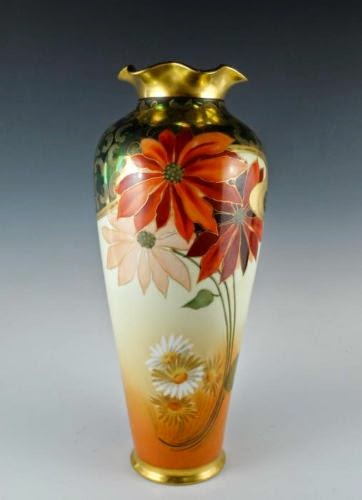

When it comes to decorating a home, adding antique pieces add a rich, layered sense of beauty (and history!). Now that spring is here, flowers and flower arrangements are definitely on my mind. Florals for spring may be a cliche, but I like to think of them as timeless instead. A beautiful floral-patterned vase can bring the feeling of spring to your home year-round. We have a few fantastic examples of fine quality hand painted floral decorated porcelain from Pickard that I wanted to show off this week.

Pickard China was founded by Wilder Pickard in Wisconsin in 1893, and soon moved in Chicago in 1897. Pickard began by offering hand painted art pieces, tea sets, and dessert sets. Pickard hired both male and female artists (many from the nearby Art Institute of Chicago, and many noted European painters) who created one-of-a-kind pieces. These early pieces of Pickard porcelain were painted on blanks imported from notable European makers.

The above vase was decorated by the German-born master painter Paul Gasper, an artist who worked for Pickard in the early 1900s. Gasper is known for his daisy motifs, which is featured on this vase along with vibrant red and pink poinsettias. The vase is accented with the artist's trademark gilded details and finished with a beautiful ruffled rim with a wide gilded border. Signed for Gasper as pictured.The blank vase was made by the Oscar & Edgar Gutherz (O. & E.G.) Royal Austria Factory.

Pickard China has been called a uniquely American style of hand painted china. One of the most sought after artists working at Pickard was M. Rost LeRoy, who painted for Pickard between 1898 and 1905. LeRoy left Pickard to join the Donath Studio which was founded by another ex-Pickard artist. This elegant pitcher at the right is a striking example of LeRoy's work: the tall form is extensively gilded and features a vivid scene of ripe cherries on the branch. The porcelain blank came from Limoges, France. The pitcher has an unusual Pickard hallmark which is infrequently found.

Because Pickard purchased its blanks from porcelain factories, antique Pickard pieces will usually have two maker's marks on the bottom: the porcelain factory's trademark, and Pickard's trademark that was applied upon decoration. Pickard remained a decorating studio only until the 1930s when they began producing their own line of porcelain blanks to be painted. Antique pieces of Pickard decorated porcelain can be difficult to find in excellent condition in large sizes like this vase and pitcher.

You can find more porcelain in the Nine Caroline Antiques store here.

Or explore all of the categories of fine antiques and collectibles at Nine Caroline Antiques.

Monday, March 16, 2015

Depictions of the Bacchanalia

The blog has moved!
Visit us at www.ninecarolineantiques.com for updated blog content
View this blog entry on the updated Nine Caroline Antiques website

Today marks the beginning of the first day of the Bacchanalia, the ancient Roman festivals celebrating the god Bacchus. Bacchus (the Roman version of the Greek god Dionysus) was the god of wine and the grape harvest, winemaking and intoxication, fertility and epiphany. The Bacchanalia festivals take place in early Spring, and possibly began as fertility rites. The celebrations also included processions and dramatic performances as well as religious rites, but the "drinking feasts" are perhaps the most well-known aspect of the Bacchanalia today. The term bacchanalia or bacchanal has come to describe any type of uninhibited (and often drunken) revelry.


The flowering of the Renaissance spurred developments in all areas of society, but it is perhaps best known for its remarkable innovations in visual art. The Middle Ages had not approved of the licentious traits associated with Bacchus/Dionysus, to say the least. Renaissance artists embraced the theme of the Bacchanalia, restoring the god of wine as an appropriate subject by associating Bacchus' life-birth-rebirth cycle with the Christian resurrection. The bacchanal in art also allowed artists to freely depict reveling nude figures under the respectable aegis of "mythology", and it remained a popular theme in art long after its association with Christian resurrection faded away.

In decorative art, the Bacchanalia will often be seen on such items as wine decanters, pitchers, or snuff boxes. These socially acceptable vices are the perfect backdrop for scenes of partying gods and mortals. The antique silver pill box depicted at the upper left is a charming depiction of a traditional bacchanal scene, with dancing nymphs in a woodland landscape.

The pitcher at the right is a nice example of the subtle use of the Bacchanal theme during the Victorian era. The silver plated pitcher is crafted in the Aesthetic style, with an ornately decorated form. The pitcher features a finial of a small figure of Bacchus, holding a goblet of wine in an eternal toast.

Today, there is a wide variety of decorative and fine art depicting bacchanal scenes, which is quite wonderful for anyone interesting in collecting these festive pieces. We have scene this motif illustrated in jewelry, trinket boxes, pottery and porcelain, and so much more. It's a delightful sub-category of fine and decorative art inspired by Classical mythology. The pieces illustrated in this post can be found in our store, and we are always coming across new and beautiful Bacchanalia-themed objects.

Thursday, March 5, 2015

Niels Erik From: Modernist Scandinavian Jewelry

The blog has moved!
Visit us at www.ninecarolineantiques.com for updated blog content
View this blog entry on the updated Nine Caroline Antiques website

No designer does Modernist quite like Scandinavian designers. This extraordinary pendant necklace by Niels Erik From is a beautiful example of the heights of Scandinavian jewelry design.

Niels Erik From (1908—1982) is considered among the greats of Danish silver design, along with such notable names as Georg Jensen. From trained as a silversmith and opened his first workshop in 1931 at the age of 23.

From's early jewelry pieces reflect the Skønvirke style, a Scandinavian development of the Art Nouveau and Arts and Crafts movements. These early pieces are explorations of the Arts & Crafts and Art Nouveau interest in naturalistic designs incorporating flowers, leaves, and other foliage, as well as animal motifs. The pieces were usually beautifully detailed and have a rather romantic air.

This pendant necklace is a striking example of the later Modernist pieces that came out of From's workshop. The necklace is hand crafted with a boldly sinuous shape crowned by a large translucent amber cabochon. The Modernist designs are striking yet simple, with a sculptural elegance.

This pendant is hallmarked "NE From Sterling Denmark 925s", but smaller pieces are sometimes simply marked "From" or "N.E. From" in an italic script.


You can find more example of Scandinavian (primarily Danish) design here.

Examine this Niels Erik From pendant necklace in greater detail.

Monday, February 23, 2015

Royal Doulton Toby Jugs

The blog has moved!
Visit us at www.ninecarolineantiques.com for updated blog content
View this blog entry on the updated Nine Caroline Antiques website

 Toby Jugs, or character mugs, are an interesting type of collectible with a rich history in England that dates back to the 18th century. The inspiration for the Toby Jug likely hails from an old tavern song called "Brown Jug" which commemorates the life and death of the Staffordshire gent Toby Philpot, known for his drinking prowess (probably based on the real life story of a Yorkshire man called Henry Elwes who was said to have drunk 2,000 gallons of ale). The song was popularized in 1761 when it was published with an accompanying illustration that became the basis for the traditional Toby jug figure: a round old gentleman holding a tankard of beer and thoroughly enjoying himself. Some of the earlier jugs (like the one pictured below) might have been used to carry beer to the table. This type of jug has a lid, disguised as Toby's tricorn hat. This sort of archetypal drinking gentleman mug is known as an Ordinary Toby.


In the early 20th century, designers at Royal Doulton conceived of the possibility of reviving the old Staffordshire Toby jug: a tradition popular in the 18th and 19th centuries. The company expanded on the Staffordshire jugs by creating a series of character jugs based on English legend, history, literature, modern personalities, and music. These jugs were produced as a modern take on an old art form and included figures that would be most appealing to the up and coming generations.

Vintage Toby jugs from Royal Doulton encompass a wide range of themes and motifs: Biblical characters (e.g. Noah), mythological characters (e.g. Neptune, Merlin, Santa Claus), figures from folklore (e.g. Robin Hood, Toby Philpot himself) or literature (e.g. Tony Weller from the Pickwick Papers, Robinson Crusoe, Rip Van Winkle, Falstaff), or historical figures and archetypes (e.g. Queen Victoria, Captain Henry Morgan, North American Indian, the Night Watchman, the Guardsman, the Lawyer, the Fireman, the Lumberjack, etc).

The jugs tend to depict wonderfully evocative personalities with richly textured faces full of character. The faces range from kindly and avuncular (in the case of Santa Claus here) to weather-beaten and perhaps a little tipsy (as with our Lobster Man).

A large single-owner collection of vintage Toby jugs (character jugs) by Royal Doulton can be found here.

Or check out our store for more unusual vintage collectibles.


Thursday, February 19, 2015

Antique Italian Micromosaics - A Grand Tour Souvenir

The blog has moved!
Visit us at www.ninecarolineantiques.com for updated blog content
View this blog entry on the updated Nine Caroline Antiques website

Micromosaic (or micro mosaic) jewelry has a long and storied past. Micromosaics are created with extremely small tesserae, or mosaic pieces of glass. Historically, micromosaics date as far back as the ancient Byzantine and Roman empires. Byzantine micromosaics were especially fine, with tesserae as small as those found in the finest quality micromosaics of the 19th and 20th centuries. Byzantine mosaics are very rare and were almost all religious icons. The best known Byzantine micromosaic, depicting the Twelve Great Feasts of the Greek Orthodox Church, is located in the Bargello in Florence.

Micromosaics reached the height of their popularity during the mid 19th century. During this time period, anyone who was anyone would take a Grand Tour through Europe, inevitably spending an extended period in Italy. Rome became the center of production for micromosaic pieces which were then sold to the Grand Tour visitors. The souvenir micromosaics took many forms: jewelry, snuffboxes and trinket boxes, small panels to be set in furniture, paperweights, and small framed art pieces. Micromosaic jewelry quickly became extremely popular as the Grand Tour souvenir of choice.

Many pieces made for the tourist trade were standard Italian landscape scenes and were of nice but average quality. Usually, the pieces would depict such landmarks as the Colosseum or St Peter's Basilica, or ancient motifs like Pliny's doves and were a nice souvenir for the average visitor. However, certain jewelers in Italy concentrated on elevating the micromosaic to a glorious work of art.

This 19th century micro mosaic depicting Cupid (or Eros) in a chariot pulled by lions is signed Barberi, and is one of the most beautiful we've seen in a while. The mosaic itself is finely detailed and is surrounded by a Classical frame in 18k gold. The finest micromosaics used very small tesserare in a subtle color range to create delicately detailed scenes; the depth and realism of a  fine antique micromosaic is quite marvelous.

Examine this antique Italian micromosaic brooch in greater detail.

Wednesday, February 18, 2015

Edwardian Elegance - Turn of the Century Jewelry


The continuing popularity of Downton Abbey, the runaway hit chronicling the lives and loves of an aristocratic English family in the early 20th century, has inspired renewed interest in the style of the period.The Edwardian era stretched from c1890-1915.

This seed pearl and natural ruby sautoir (or tassel) necklace is a beautiful example of turn of the century jewelry that might have been worn by Lady Cora or Lady Mary at Downton Abbey, particularly in the early Edwardian period. A sautoir is a necklace that is a long single strand, in this case fabulously constructed from a cascade of delicate seed pearls, without a clasp or closure. This type of necklace gained popularity at the close of the 19th century in response to the lengthening silhouette of women's fashion during the Edwardian age. The sautoir was a striking accompaniment to the elongated, columnar dresses, whether worn loose down the back, or looped around the neck like a scarf. This necklace is set with an abundance of natural rubies which complement the dramatic seed pearl ropes and tassels quite nicely. The natural beauty of the pearls and gemstones is more common in earlier Edwardian pieces, before the aristocracy's love affair with platinum and diamonds really took over.

This particular necklace is a fine, earlier example. As the Art Deco movement gained popularity in the 1920s, sautoir necklaces began to reflect the design principles of the movement with bold geometric pendants set with diamonds.

Edwardian jewelry was often delicate and light, constructed in platinum over yellow gold. The brooch above, an Edwardian sapphire platinum and 14k gold filigree brooch is a classic example of the type. Platinum and diamond were the most popular combinations in jewelry of the time; sapphires were considered a striking and desirable contrast to platinum as well. Later Edwardian jewelry was typically a monochromatic palette of sparkling colorless diamonds against platinum. The transitional pieces from the Edwardian to Art Deco period of jewelry design can be quite beautiful.

Explore antique Edwardian jewelry in our store.

Or visit us online for other jewelry, antiques, and rare objects.


Tuesday, February 17, 2015

Celebrate Mardi Gras with Vintage Bar Style

It's time for Mardi Gras! Today is Fat Tuesday, our last hurrah before Lent. The Carnival season is culminating tonight and we're celebrating appropriately. We're always excited to bring out the glamorous vintage and antique barware to help us celebrate in style.

For your next cocktail party or get-together, consider mixing and matching vintage with antique for a boldly unique hosting style. We're combining a vintage set of oversized whisky tumblers with an antique cut glass decanter for a particularly eye-catching effect.

The crystal and chrome tumblers have a sleek look that straddles Mid Century Modern and Art Deco. The set of eight tumblers come with a caddy, which makes it a breeze to serve cocktails for a crowd. And for those who don't like cocktails, a nip of Scotch from a cut crystal decanter (with an antique decanter label, of course) is an elegant sufficiency.

If you're more of a traditionalist, consider the classic mint julep cup. The mint julep is a traditional cocktail with its roots firmly planted in the South. Antique American coin silver mint julep cups date back to the 19th century and should be accompanied by specialized long sterling silver straw-spoons for a truly unique and authentic experience.


The set above is a modern take on the classic mint julep cup from the noted Kentucky firm Wakefield-Scearce. The set of twelve mint julep cups are beautiful examples of a traditional yet timeless design.  

Layering antique and vintage objects with modern pieces is a great way to bring a fresh and individual personality to your home. There are so many amazing options for antique and vintage barware, tumblers, glasses, goblets, shakers, and other cocktail accessories.

Check out our store for more ideas to style your next cocktail party with fine vintage and antique barware.