Showing posts with label England. Show all posts

Monday, February 23, 2015

Royal Doulton Toby Jugs

The blog has moved!
Visit us at www.ninecarolineantiques.com for updated blog content
View this blog entry on the updated Nine Caroline Antiques website

 Toby Jugs, or character mugs, are an interesting type of collectible with a rich history in England that dates back to the 18th century. The inspiration for the Toby Jug likely hails from an old tavern song called "Brown Jug" which commemorates the life and death of the Staffordshire gent Toby Philpot, known for his drinking prowess (probably based on the real life story of a Yorkshire man called Henry Elwes who was said to have drunk 2,000 gallons of ale). The song was popularized in 1761 when it was published with an accompanying illustration that became the basis for the traditional Toby jug figure: a round old gentleman holding a tankard of beer and thoroughly enjoying himself. Some of the earlier jugs (like the one pictured below) might have been used to carry beer to the table. This type of jug has a lid, disguised as Toby's tricorn hat. This sort of archetypal drinking gentleman mug is known as an Ordinary Toby.


In the early 20th century, designers at Royal Doulton conceived of the possibility of reviving the old Staffordshire Toby jug: a tradition popular in the 18th and 19th centuries. The company expanded on the Staffordshire jugs by creating a series of character jugs based on English legend, history, literature, modern personalities, and music. These jugs were produced as a modern take on an old art form and included figures that would be most appealing to the up and coming generations.

Vintage Toby jugs from Royal Doulton encompass a wide range of themes and motifs: Biblical characters (e.g. Noah), mythological characters (e.g. Neptune, Merlin, Santa Claus), figures from folklore (e.g. Robin Hood, Toby Philpot himself) or literature (e.g. Tony Weller from the Pickwick Papers, Robinson Crusoe, Rip Van Winkle, Falstaff), or historical figures and archetypes (e.g. Queen Victoria, Captain Henry Morgan, North American Indian, the Night Watchman, the Guardsman, the Lawyer, the Fireman, the Lumberjack, etc).

The jugs tend to depict wonderfully evocative personalities with richly textured faces full of character. The faces range from kindly and avuncular (in the case of Santa Claus here) to weather-beaten and perhaps a little tipsy (as with our Lobster Man).

A large single-owner collection of vintage Toby jugs (character jugs) by Royal Doulton can be found here.

Or check out our store for more unusual vintage collectibles.


Friday, February 13, 2015

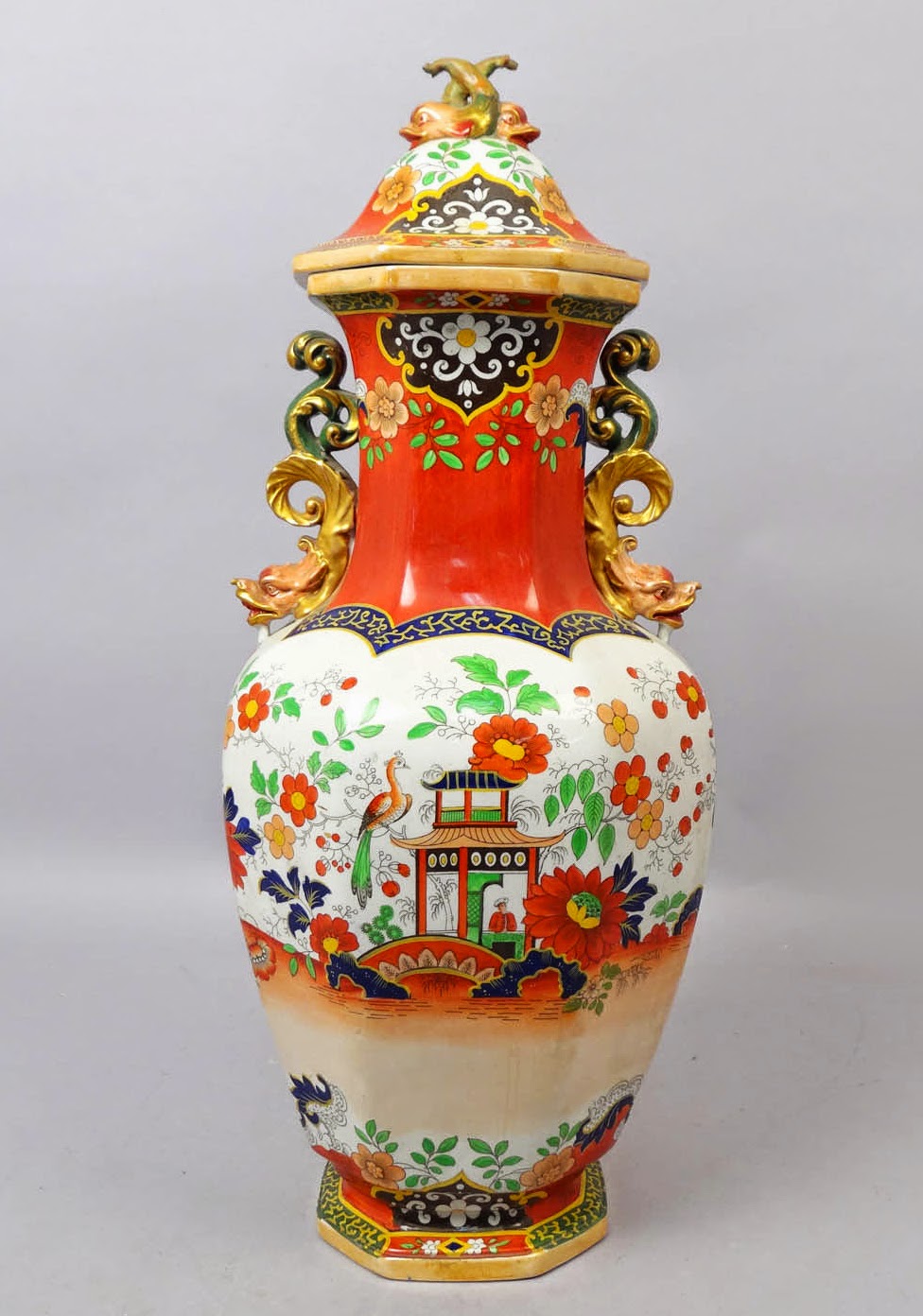
The Unusual Story of An Imari Style Urn


Japanese English Imari Design Ironstone China Urn
Today we put the spotlight on an antique porcelain urn whose seemingly straightforward (and quite beautiful) appearance belies an unusual background.

In the 19th century, English manufacturers were realizing the great untapped European market for Japanese Imari porcelain. Japan had been largely closed to the Western world for years, limiting its foreign trade strictly through Dutch and Chinese traders. Japanese goods were admired for their beauty and prized for their scarcity. 19th century English manufacturers capitalized on this and subsequently set to making fine quality reproductions of traditional Japanese Imari porcelain wares.

This monumental urn is a beautiful example of the English reproductions of Japanese designs. The urn is influenced by the vibrant Imari-type patterns, with bold colors and ornate figural handles depicting dragons and fish. The transfer print decorations are finely detailed and vividly colored using classic Imari motifs. The base exhibits an underglaze transferprint English Royal Arms mark with rampant lion and unicorn. This variation of the mark was used in England as early as 1837.


Hallmark of Japanese English Imari Design Ironstone China Urn This mysterious hallmark is where the story of this urn becomes so interesting. The lion and unicorn hallmark would seem to indicate this urn was one of those 19th century English reproductions. Notably absent from the mark, however, is any indication of the specific potter, potter location, or pattern name. As English pottery was always marked for maker, it is a near certainty that this urn is a later copy of the types of Imari porcelain crafted in England. Considering the high glaze and style, it is most likely that this urn is actually an early 20th century Japanese copy of the English imitations of the original Japanese Imari decorated porcelain.

This is a wonderful work of decorative art displaying a fine degree of craftsmanship. The convoluted background of the piece - an antique copy of an antique imitation of traditional Japanese design - makes it a fascinating piece of design history.

Learn more about this Japanese English Imari design ironstone china urn here.

Visit our store for more fine quality antique porcelain pieces.

Thursday, February 12, 2015

The Guild of Handicraft & Superb Enamel Decoration

Guild of Handicraft Charles Fleetwood Varley enameled sterling silver box
This turn of the century box is a beautiful example of decorative art from the British Arts & Crafts movement.

The Arts & Crafts movement was inspired largely by the writings of John Ruskin and the ethos of the artist William Morris. The British Arts & Crafts movement encompassed a wide range of social and artistic beliefs. Its supporters believed that art should be available to everyone of every walk of life. As William Morris said, “…I do not want art for a few; any more than education for a few; or freedom for a few…” The movement began as a reaction against machine production, and searched for a new aesthetic design that embraced simplicity and high quality materials.

Charles Robert Ashbee (1863-1942) was a primary figure in the entrepreneurial side of the Arts & Crafts movement. He founded the Guild of Handicraft in the 1890s which employed numerous craftsman and artisans to create jewelry, enamels, furniture, and ironwork, as well as other pieces of “handicraft”.
Charles Fleetwood Varley joined the Guild of Handicraft in the 1890s and quickly gained fame specifically for his sophisticated creations in enamel. When the Guild dissolved in 1907, Varley found success in marketing his richly detailed enamels at the noted retailer Liberty & Co, where they became much sought after.

This box is a striking example of Varley’s painterly approach to enamelwork. The round panel depicts a peaceful, lightly wooded landscape at sunset. The vibrant autumnal colors are used to a particularly evocative effect. The round box itself is crafted in hand hammered sterling silver, date marked for 1903, placing it within Varley’s time with the Guild of Handicraft. The box is signed in the enamel by Varley, as pictured.

Learn more about this amazing Guild of Handicraft enameled silver box here.

Find other antique enamel and sterling silver works of art in our store.