Thursday, September 10, 2015

Baltic Amber Jewelry Pieces

 The blog has moved!
Visit us at www.ninecarolineantiques.com for updated blog content
View this blog entry on the updated Nine Caroline Antiques website

Autumn is approaching, and so is the opportunity for fun fall accessories. Baltic amber, which comes in a variety of yellow and orange hues, is a severely underrated way to adorn yourself for the season.

Though it does appear to be a gemstone, all real amber is actually fossilized trees. Baltic amber is amber that has been mined from near the Baltic Sea.  

Baltic amber was formed over the course of 45 million years, from fossilized pine tree resin that grew in Northern Europe to Scandinavia. When the climate in that region began to get warmer, the pine trees produced resin or sap. this eventually fossilized and became hard and stable through oxidation. 

Authentic Baltic amber contains succinic acid, which works like ibuprofen when worn against the skin, and produces a soothing smell when in burned or in contact with human skin oils. 

Baltic Amber has also been said to help with pain relief, inflammation reduction, and energy restoration. In Europe, Baltic amber is commonly known as "teething jewelry," due to its pain-relieving properties. It also is said to help with joint pain when worn near the site of pain. 

There is a legend, according to Lithuanian mythology, about where Baltic amber comes from: The goddess Jurate, daughter of Perkunas, the god of thunder, lived in an amber palace in the Baltic Sea. 

A fisherman named Kastytis chose to cast his nets near Jurate's amber palace, so Jurate set her servants to tell Kastytis that fishing there was forbidden. Kastytis kept fishing anyway, so Jurate went to confront him herself.
Of course, upon meeting him in person, Jurate fell madly in love with Kastytis and brought him to live with her in her amber palace, even though she was already betrothed to another god.   


When he heard that his daughter was living with a mortal, Perkunas was furious. In his anger, he destroyed the amber palace by sending a lightning bolt into it, which killed Kastytis. Jurate remained chained to the palace's ruins for all eternity. 

It is said now that when there is a storm in the Baltic Sea, pieces of Jurate's amber palace wash up on shore. Some pieces are teardrop shaped -they are said to be Jurate's tears from crying for her lost love. 

Whether you choose to wear Baltic amber for its healing properties, or for its tragic place in Lithuanian mythology, Baltic amber makes a wonderful timeless accessory, 45 million years in the making. 

To shop for some of our amber pieces, click here.  


Friday, September 4, 2015

Friday Focus: Margaret Bourke-White

The blog has moved!
Visit us at www.ninecarolineantiques.com for updated blog content
View this blog entry on the updated Nine Caroline Antiques website

Because we have recently acquired some of her very cool original prints and because it is Friday, we're making the first ever female war photojournalist, Margaret Bourke-White our first ever Friday focus.

Margaret White was born in New York City in 1904. She was educated at a variety of universities from 1922-1927 including Columbia University, the University of Michigan, Western Reserve University, and Cornell.
During that time she picked up photography as a hobby. By the time she left Cornell University in 1927, she was returning to New York city to pursue freelance opportunities.

Also during this time she picked up her mother's maiden name (Bourke) to create the professional hyphenated name we recognize today.

After a brief stint as an architectural photographer and becoming one of the pioneers of industrial photographers,  Bourke-White began working for Fortune Magazine in 1929.

In 1930, while she was on assignment in Europe to photograph the Krupp Iron works in Germany, Bourke-White became the first foreign photographer to have complete access to the Soviet Union when she independently documented the progress of Joseph Stalin's First Five Year Plan.

While this achievement led to her being named one of the 20 most notable women in 1935, Bourke-White became so distraught by the lives of the Soviet people that she vowed that she "would undertake only those photographic assignments which I felt could be done in a creative and constructive way."

Bourke-White became one of the first four staff photographers for the fledgling Life magazine when it began its circulation in 1936. Throughout the 1930s she traveled for Life, taking photos of the areas affected the most by the Great Depression and the Dust Bowl. Both of the pictures in our small collection of Bourke-White's photos are from this part of her career.

In 1941 Bourke-White went back to the Soviet Union with hundreds of pounds of camera equipment to be the first photographer in Moscow during the German raid on the Kremlin.
She was also hired to fly with and photograph American WWII B-17 bombers during an actual air raid. One of the pictures from the shoot included Bourke-White dressed in her flying gear, and it inexplicably became one of the most popular American Army pinup posters of the war.
Bourke-White is also famous for taking portrait photos influential figures like Winston Churchill, Gandhi, Franklin D Roosevelt, Pope Pius XII.

Her final assignment was to cover the Korean War. During this time she began to have symptoms of Parkinson's disease, and by the mid 1950s she could no longer continue to work. She retired and published her autobiography Portrait of Myself in 1963 as well as several other books. She retired from Life Magazine in 1969 and passed away in Stamford, Connecticut in 1971.

The two original prints we have from Bourke-White's early career are special to us because they represent a grim period in American history presented by a talented photographer in a way that makes them seem creative and even hopeful. She photographed not just major events like wars and ecological disasters, but the way these events affected the lives of the people living through them.

You can check out our original prints from Margaret Bourke-White in our Ebay store here.

Thursday, August 27, 2015

Jenness Cortez

The blog has moved!
Visit us at www.ninecarolineantiques.com for updated blog content
View this blog entry on the updated Nine Caroline Antiques website

With the upcoming end to horse racing season in Saratoga, as proud upstate New Yorkers we have decided to share a few of the paintings in our inventory that are important to the racing culture.

Jenness Cortez (1944- ) is an upstate artist whose paintings depicting the athleticism of Saratoga's racing horses had made her a famous name in Realist art.

Cortez was born in 1944 in Frankfurt, Indiana. She began her art studies when she was 16, under the guidance of noted Dutch painter Antonius Raemakers. She attended the Art Students League of New York after graduating from the Herron School of Art in Indianapolis, IN.

Following her formal education, Cortez moved to Albany, New York to work as a commercial and editorial illustrator for the biweekly community newspaper "The Washington Park Spirit." In 1974 Cortez was commissioned to create original paintings of endangered species in the Adirondack Mountains by the New York State Museum. Her paintings from that year are still apart of the Museum's permanent collection.
Cortez has been commissioned to create commemorative etchings of thoroughbred racing's Horse of the Year every year since 1981. This prints we have in our inventory are original works from Cortez spanning from the years 1983-1993.

Cortez's style is described as realist work that has been filtered through "the minds's eye."

Throughout the 1980s and her work in Saratoga, Cortez's fame gained momentum as she was commissioned on more commercial and gallery projects, which solidified her career as a prominent New York capital region artist.
In the mid 1990s, Cortez moved her interest to encompass landscapes and cityscapes, and more recently, still life.

Cortez is currently working on new projects from her studio in Averill Park, NY where her pieces are featured in she and her husband's gallery.

Own these original vintage estate-found prints from Jenness Cortez's Saratoga days: shop here. 

Monday, August 24, 2015

A Beginner's Guide to Turkish Coffee Sets

The blog has moved!
Visit us at www.ninecarolineantiques.com for updated blog content
View this blog entry on the updated Nine Caroline Antiques website

Over the past few years, Turkish coffee has grown in popularity in English-speaking countries due to its unique preparation process and flavor.

Recently we have had a few Turkish coffee sets come to us as estate finds, and we thought it would be interesting to shed some light on the culinary tradition of brewing Turkish coffee.

Turkish coffee is not an actual type of coffee -it is a preparation method, so there is no specific type of coffee bean used when preparing the drink.
The process begins with a very finely ground coffee. Usually, grinding the coffee beans to a powder-like texture requires the use of a burr mill or a traditional Turkish hand grinder.

Next, heat water up on a stove in a cezve (Turkish coffee pot), bringing it to a brief boil before adding 1-2 heaping teaspoons of coffee (and as much sugar as desired) per serving he/she plans to make.
Once the coffee grounds sink to the bottom of the pot, the coffee maker can stir the mixture several times and put it over low heat.
Some techniques advise coffee makers to remove the coffee from the heat, stir it, then boil it once or twice more. 
 It should form a think froth or "kaimaki". if the water boils too quickly, the coffee will lose much of its flavor and the foam will evaporate.

The foam is the key part of Turkish coffee, so serving the drink is more of an art form than part of a recipe. The goal of serving Turkish coffee is to get equal amounts of rich foam in each cup. The result is a frothy, strong cop of coffee that can be enjoyed with a dessert or any kind of treat.

Though having your own vintage Turkish coffee set might excite those interested in antique cultural decor, there are certain precautions to take when actually preparing coffee in an older cezve.

If a cezve is copper or brass like the one picttured from our inventory, it is always a good idea to check the inside of the pot to look for scratches. Only a cezve lined with unscratched tin are safe for brewing and serving. 

There are many variations of coffee brewing that involve methods similar to Turkish coffee making, such as Greek coffee, Bosnian coffee, and Czech coffee. They all are all brewed in a slightly different manner, although they do all involve the main technique of pouring coffee directly into heated or boiling water to create a thick foam.

There are mystical factors that may play into Turkish coffee's growing popularity in America; the grounds left after drinking the brew can be used for fortune telling. This type of fortune telling using coffee grounds or tea leaves is called tasseography. After the coffee drinker finishes his/her cup, the grounds can be dumped into a saucer, and the patterns can be examined to determine aspects of the drinker's future.
Fantastic considerations aside, we think Turkish coffee is an excellent way to enjoy a strong brew, and with the impending fall weather approaching, Turkish coffee may be just what we need to stay toasty.

Take a look at our vintage Turkish coffee set here.

Wednesday, August 19, 2015

Vintage 1951 Amelia Opdyke Jones "Subway Sun" Ad Posters

The blog has moved!
Visit us at www.ninecarolineantiques.com for updated blog content
View this blog entry on the updated Nine Caroline Antiques website

This is one of the more fun and interesting vintage finds we have seen recently: a set of four New York City subway ads printed in 1951. 


The set of 21" x 11" posters take the form of a newspaper header titled "The Subway Sun." Cartoonist Amelia Opdyke Jones (who always signed her work "Oppy") created these types of ads for the New York City Transit Authority in the 1940s and 1950s to promote good behavior and etiquette among subway users.
The New York Transit Authority originally hired Oppy to create cartoons to warm subway riders to the fare increase in the 1940s, however she Subway Sun ads were also eventually used to advertise technological improvements on the subway ("100 Years of Transit Progress"), as well as to encourage citizens to utilize the subway's services ("New York is Greatest - Go Subway").


Perhaps most famously in her Subway Sun ads, Oppy called out some of the more crass behaviors some NYC subway riders were becoming more infamous for in a funny-but-too-true style. In our set particularly, there is a poster with an illustration of a man falling down the stairs to the subway interest with the caption "You can get down quicker!" while a concerned woman descending the stairs in a less deranged manner looks on. To prevent confusion, warnings to "watch your step" and "take your time" decorate the poster's top corners. Oppy also illustrated ads addressing other undesirable subway behavior, such as riders putting their feet on seats, littering, and smoking.

The Monopoly-esque characters in the ads are largely recognizable as Oppy's work, and some have speculated that the women in the ads are often modeled after the artist herself. Many of the original Subway Sun ads are on display in the New York Transit Museum, but our small inventory is available for collectors or just lovers of vintage signage. Each individual poster is signed "Oppy" and marked for the New York Transit Authority.


Tuesday, June 23, 2015

Rare c1900 RS Prussia "Tigers" Creamer & Sugar


One of the more exciting finds we've come across recently is this extraordinary RS Prussia creamer and sugar set. The set is decorated in the rare and elusive "Tigers" pattern. While we have often seen lovely pieces of RS Prussia porcelain decorated with pretty floral patterns, the amazing animal design pieces from this renowned maker are notable for their rarity and elusiveness!

The Reinhold Schlegelmilch Porcelain Factory was founded in the province of Thuringia, Germany in the 1890s. The porcelain from the factory was thin, lightweight, and translucent (all markers of fine quality porcelain). Pieces were hallmarked with a distinct green wreath and "R.S.Prussia" in red lettering. This is the factory's most recognizable mark although several others were used throughout the years. This early hallmark conferred the name of RS Prussia to pieces from the Reinhold Schlegelmilch Porcelain Factory. RS Prussia quickly gained in popularity, and the designs created during the factory's heyday were very ornate, often showing a distinct Art Nouveau influence. Collectors consider the pieces made by RS Prussia between 1900-1905 to be among the best porcelain made in Europe.

This beautiful creamer and sugar set dates to circa 1900. The pieces have elegantly ornate forms in the Art Nouveau style, with curvilinear surfaces that gracefully curve in and out. The forms have a subtly naturalistic shape that echoes the organic patterns of leaves, flowers, and vines. Each piece is decorated with a vibrantly hued transfer print of two tigers in a lush, verdant setting. The pieces are accented with gilded details. Each piece is hallmarked with the distinctive red and green RS Prussia mark.

Additional images and further information can be found here.


Friday, June 19, 2015

Nikolai Becker: Portraitist of Russian Royalty

The blog has moved!
Visit us at www.ninecarolineantiques.com for updated blog content
View this blog entry on the updated Nine Caroline Antiques website

Knight and Nude Maiden, France, Nicolas BeckerNikolai Becker (also known as Nicolas Becker), born 1877 in Russia, was the son of Nicolas T. Becker, an established architect and artist. A strict disciplinarian, the elder Becker insisted on his son’s formal education before allowing him to devote himself to art, for which the boy showed great promise from an early age. After graduating from the Imperial Institute of Ways and Communications, one of Russia’s finest educational institutes, the young Becker plunged headlong into art.

His artistic skills developed quickly, and he soon became popular among the Russian Royalty for his exceptional portraits. It was a common practice for Becker to sketch preliminary pencil drawings and paint miniature oils, some in amazing detail, of what he envisioned as the finished painting. His gift of successfully presenting a striking resemblance of his models caught at their best moments, made him one of the most sought after painters in Russia. After his brilliant career, Becker left Russia in the post-revolutionary exodus via Constantinople and settled in southern France. There he survived the terrors of the German occupation, continuing to work against all odds.

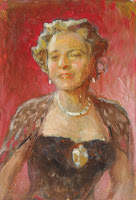
Portrait Study of Identified Russian Woman, Nikolai BeckerThe next few years were spent on the French Riviera, in Paris and Italy, where he developed his own elegant style and soon became the acclaimed “Society Portrait Artist,” of the rich and famous. His portraits spread throughout Europe including England where many a mansion or castle was graced by his work. During a short span of three years, Becker executed more than 160 portraits of the most distinguished personalities of the diplomatic world. Although he excelled in portraiture, he loved most to paint landscapes, flowers and animals.

In the late 1950s, Becker moved to New York City, and despite his advancing age, he carried on his prolific work. During this time his love of nature emanated from his canvases, often combining creatures with portraits, such as a huge portrait of his young daughter who had befriended a little squirrel, which she holds gently in her hands. Becker enjoyed his relaxing moments writing poetry, listening to music and playing chess.

Appreciating all the opportunities offered by America, in his heart Becker longed for his beloved Nice, Monte-Carlo and French Riviera. After the death of his third wife, he decided to return to France to relax under the Mediterranean sun where he painted numerous landscapes and enjoyed his remaining years until his passing in 1962.

Portrait of Nikolai Becker (Nicolas Becker)Although his portraits were known as some of the finest in the world, most were commissioned works and never reached the public market which left him little known outside his focused well-to-do adoring audience.

Two years before his death in 1960, Becker realized his life would soon end, so he willed all of his remaining collection including oil portraits, sketches, drawings, photographs of former commissioned paintings, which totaled well in excess of 250 works to his niece, Catherine Post, also of New York City. She in turn, donated a few pieces of his collection to the Columbia University Rare Book & Manuscript Library, where they are today. The larger share of the Becker collection was then willed by Post to a dear friend, John Kelly, an attorney in Fonda, NY. Kelly resided and practiced law from his family home where numerous of Becker’s paintings were on display until Kelly’s death in 2014. 

A certain number of paintings have come to us out of the upstate New York estate of a relative of Nikolai Becker, and are currently available in our store. Click here to see the entire group (link will open in new window).


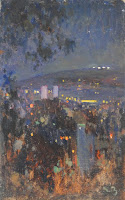
Cityscape at Night, France, Nicolas BeckerCannes, France Seascape Landscape Painting, Nicolas BeckerFloral Arrangement Still Life, Nikolai Becker
Waterfall Landscape Scene, France, Nikolai BeckerWooded Park Landscape Painting, France, Nikolai BeckerSquirel in Pine Tree, France, Nikolai Becker

Beach Landscape, Cannes, France, Nicolas BeckerLandscape with Palm Trees, Cannes, France, Nicolas BeckerPortrait Study of Ballerina, Nicolas BeckerPortrait Study of Elegant Woman, Nikolai Becker