Wednesday, June 17, 2015

Audubon's 'Birds of America' - Four Original Prints

The blog has moved!
Visit us at www.ninecarolineantiques.com for updated blog content
View this blog entry on the updated Nine Caroline Antiques website


"The Birds of America" is the iconic work of hand-colored, life-size prints by the famed naturalist, ornithologist, and illustrator John James Audubon. The book was first published as a series between 1827 and 1838 with the intent to document every known bird in the United States. Audubon painted over 1000 individual birds, including six now-extinct birds: the Carolina parakeet, passenger pigeon, Labrador duck, great auk, Esquimaux curlew, and pinnated grouse.

Four original prints from the 19th century "double elephant" editions published by Robert Havell & Sons are now available exclusively in our store. These beautiful pieces of Audubon's "Great Work" are an extraordinary feat of observation and artistry, and would be a remarkable addition to any collection.

The full group can be found at our store.

John James Audubon (1785-1851) was born in the French colony of Saint-Domingue (now Haiti) as Jean-Jacques Audubon. His father, Jean Audubon was a sugar plantation owner as well as a French naval officer (and privateer) who helped the American cause during the Revolutionary War. The rising slave unrest in the Caribbean urged Audubon Senior to sell part of his plantation, purchase property in Pennsylvania, and then return to France with his children in 1791. John James Audubon was drawn to birds and nature even as a boy, roaming the fields around his home to draw birds eggs and nests. 

In 1803, John James Audubon immigrated to the United States to avoid conscription to Napoleon's armies. He took up residence in Pennsylvania, a few miles from Valley Forger, and soon became consumed with naturalistic pursuits. He set about studying American birds, noting the close ties between the environment or nature of a place and the accompanying common traits of its wildlife. Audubon became determined to scientifically record behavior and illustrate all of the known American birds in the most thorough and realistic manner possible.

Audubon painted 435 illustrations of over 1000 individual birds, using primarily watercolors and pastel crayons. Unable to find financial support in America for his "Great Work", he sailed to the United Kingdom with 250 of his original illustrations. In 1827, he joined with Robert Havell, a London engraver to create "The Birds of America", also known as the "Havell Edition" or the "Double Elephant Folio". The edition was printed on the largest format paper available for printing in the early 19th century: approximately 26" x 39". Audubon insisted on this impressive size in order to accommodate the life-size scale of his drawings. Each plate was engraved from Audubon's original illustration and then hand-colored. The cost was prohibitively expensive but found support from such notables of the day as King Charles X of France and Queen Adelaide of Britain (wife of King William IV). Many of the original subscribers chose to bind their folios into large four volume sets once the publication was complete (which took over ten years to finish). The  A later edition of "The Birds of America" was published by J. T. Bowen of Philadelphia in a smaller and therefore more affordable format.

Only 120 complete copies of "The Birds of America" from the original Havell Edition are known to survive. Many are held in public institutions, and the New York Historical Society holds all of Audubon's preparatory watercolors. These beautiful prints are a remarkable piece of history. Take a closer look at the prints available in our store here.


Monday, June 15, 2015

Vintage Art Deco Jewelry: The Etsy Collection

After a nice, meditative break, Nine Caroline is back and even more fabulous than before, and with a few updates: We've opened up an Etsy shop! And we'll be managing some of our jewelry and decorative antique sales via our online shop. 

Check our new Etsy digs out here

Moving our inventory around has allowed us to rediscover some pieces that represent a glamorous touchstone in the history of art and design. A few of the pieces we've moved to our Etsy shop are wonderful examples of Art Deco jewelry. A lot of the items we receive can be classified as a part of the Art Deco movement --A movement concentrated heavily in the use of elegant and non-traditional shapes, lines and designs. 

Art Deco, or Syle Moderne originated as an architecture and decorative arts movement in the 1920s as a response to, and evolution of the Art Nouveau, Cubism, and The Bauhaus movements.
    Art Deco artists also pulled influence from Egyptian and American Indian designs, as well as elements from nature. Art Deco style reflects chic modernity, technology, and a futuristic aesthetic.

Fabulous jade and 14k gold Art Deco necklace
While the Art Deco movement began in the 1920s in terms of art and architecture, Art Deco Jewelry become  popular in the 1930s. The Art Deco design represented modernist art turned into fashion intended to pull away from traditional forms in a sleeker and more elegant manner than previous styles.

Our assortment of Art Deco rings, necklaces, and brooches are characterized by beautiful color combinations, smooth lines, and geometric shapes and designs both simple and elaborate.
Initially, Art Deco was a luxury style, employing sleek and iridescent materials like crystal, pearl, silver, turquoise and jade. Jewelry from the Art Deco movement was designed primarily to make a statement in an elegant, less floral, adorned and detailed fashion than its Art Nouveau and Victorian Predecessors. 

The Art Deco style is not limited to vintage jewelry, interior design and architecture. Many contemporary artists are classified as Art Deco representatives. We recently came into a collection of modernist brooches hand designed by artist Nelly Natzler, sister of famed modernist ceramicist Otto Natzler. 

Handcrafted brooch by Nelly Natzler
Our collection of brooches is punctuated perfectly by our assortment of Natzler originals.
These brooches are charmingly characterized by bold and pastel hues, combined with sleek lines and unconventional shapes to create one-of-a-kind pieces that remain timelessly fashionable.

 Natzler was an Austrian born artist and the older sister of Otto Natzler. Nelly and Otto, both born in Vienna, were interested in the arts and studied various mediums. Otto studied violin and then textile design until meeting his second wife, Gertrud, who introduced him to ceramics. Otto and Gertrud would go on to fantastic success with their partnership in the United States. Nelly, a lesser known Natzler, but nonetheless an artist in her own right, won a $5,000 prize in a Paris art show in 1938. She astutely used her winnings to help her family flee from the then German invaded Austria to the United states. 


Hand crafted brooch by Nelly Natzler
This jewelry came to us from an elderly couple in Upstate New York. This couple knew Otto & Gertrud's sister-in-law, Cora Natzler. Cora was in possession of this brooch and kindly gifted it to the couple. 

This wonderful enamel on copper brooch painting depicts an abstract, geometric design in fine blue, green, pink, and yellow colors. It is singed with her initials "NN." 

Art Deco and modernist styles like these have made thier way back into the main focus of popular culture in movies such as the 2013 remake of The Great Gatsby with Leonardo DiCaprio, and in wedding fashion with the growing popularity of Art Deco gowns.


Art Deco will always be a staple of modernity, even more than 90 years after the movement began. Stay chic with 9CA and visit our Etsy shop to view our collection of Art Deco and modernist jewelry. We've got vintage pieces and other unique treasures like these to grace our inventory, and we'd love to share them with you.

Monday, April 27, 2015

Cupid & Psyche Jewlery

The blog has moved!
Visit us at www.ninecarolineantiques.com for updated blog content
View this blog entry on the updated Nine Caroline Antiques website

19th Century Victorian Butterfly Winged Psyche Bracelet
The ancient myth of Psyche and Cupid is an enduring tale of love and trust, and has been a popular motif in painting, sculpture, and jewelry for thousands of years. Psyche and Cupid is one my my favorite themes in jewelry, and I'd like to show off a few pieces we've found.

Psyche was the youngest and most beautiful daughter of the rulers of an unnamed city in ancient Greece. Her beauty was so great that the citizens of the city began to worship Psyche instead of (properly) worshiping Venus (Aphrodite), the goddess of love and beauty. Venus was offended that a mortal woman has usurped her rightful devotees and sent her son Cupid (Eros), the god of desire, to work her revenge. Venus ordered Cupid to shoot Psyche with one of his arrows and force her to fall in love with the most hideous monster he can find. When Cupid saw Psyche, he dropped the arrow meant for her and scratched himself instead, falling deeply and passionately in love with the beautiful young woman.

Antique Carved Shell Cameo of PsycheAlthough Psyche was the most beautiful mortal woman in the world, her noble
parents were unable to find anyone to marry her. Fearful that their family had incurred the displeasure of the gods, the king and queen consulted an oracle and were told that Psyche had been fated to marry a monster. She was to be taken to the top of a mountain and left there to meet her fate.

The West Wind spirited Psyche away to a beautiful palace with invisible servants. Every night, her husband visted her in the darkness and warned her that she must never try to see him. Although her invisible husband was kind, Psyche grew homesick. She persuaded her husband to allow her sisters to visit and lift her spirits. When her sisters arrived, however, they were overcome with jealousy. When the sisters learned Psyche had been warned never to try to see her invisible husband, they persuaded her that her husband must be a horrific monster. The sisters gave Psyche a candle and a knife, telling her that she must kill her husband before he killed her.

Cupid & Psyche Cameo BroochPsyche's invisible husband came to visit her in the night as usual. When he fell asleep, she took up the candle and knife. To her shock, the light revealed the most beautiful young man she had ever seen: Cupid. In her surprise, Psyche dripped hot wax on Cupid's shoulder, awakening him. Cupid immediately fled the opulent palace and his confused, despairing wife.

Psyche wandered the countryside looking for her husband, finally seeking out the help of Venus in desperation. Venus set many trials and tribulations for Psyche to endure, but Psyche's kind heart and gentle nature invariably led her to find help to pass each trial successfully. When Cupid heard that his wife was in the power of his spiteful mother, he appealed to Venus to stop her persecution. At long last, the pair were reunited and Psyche was anointed a goddess in her own right. And they lived happily ever after.

Antique Psyche Cameo NecklacePsyche is almost always depicted with butterfly wings, although wings are never actually mentioned in the myth. Many of the cameos that depict Psyche will show her with butterfly wings in her hair, or with butterflies surrounding her. The butterfly symbolizes the soul in many mythologies, and is a key part in Psyche's symbolic tradition.

The story of Cupid and Psyche is a wonderful myth. On its surface, it is a story of love that begins in mistrust and yet eventually conquers any number of difficulties. It can also be read as an allegory for the soul, its struggles and resurrection. It's a wonderful motif for jewelry: depicting female and male beauty, with a deeper meaning for those who look for it.

We have seen several beautiful pieces of antique jewelry with the Cupid and Psyche theme. One of my current favorites is this Victorian era bracelet with a small medallion depicting butterfly-winged Psyche holding a lyre (one of Cupid's attributes).

To see more antique jewelry, check out our store.


Thursday, April 23, 2015

Battle Relics from the Spanish-American War

The blog has moved!
Visit us at www.ninecarolineantiques.com for updated blog content
View this blog entry on the updated Nine Caroline Antiques website

Spanish-American War battle flag remnant from the USS Brooklyn
On this day, April 23rd 1898, Spain declared war on the United States of America. Tensions had been running high between the two countries, largely due to American's meddling during the Cuban War of Independence. "Yellow journalism" from two of the biggest names in American journalism, Joseph Pulitzer and William Hearst, whipped up public opinion to a fever pitch which was only heightened by the mysterious explosion and sinking of the USS Maine on February 15, 1898.

Political pressure and public opinion pushed President McKinley into a war with Spain he had hoped to avoid, and the US Navy began a blockade of Cuba on April 21st 1898. Spain declared war on April 23rd. On April 25th, United States Congress declared that the war had begun April 21st with the Cuban blockade. This began the ten week war which was fought mainly in the Pacific and Caribbean.

We often come across interesting pieces of historical memorabilia from the Spanish-American War. Public opinion was strongly in favor of the war and approximately 125,000 soldiers from across the nation volunteered to fight.

Spanish-American War battle flag remnant from the USS Brooklyn - detailThis flag remnant is a particularly interesting piece of Spanish-American War memorabilia that came to us from an upstate New York estate. This battle flag fragment flew over the USS Brooklyn, a United States Navy armored cruiser. The USS Brooklyn was launched in 1895 and then became the flagship of the Flying Squadron under Commodore W. S. Schley on 28 March 1898. The cruiser was a key vessel in the Battle of Santiago de Cuba on July 3, 1898, a decisive battle in the American victory over the Spanish Fleet. This flag fragment is framed under glass with a hand written note reading: A piece of the battle flag of the Brooklyn which flew [.....] Maine on July 3, 1898.. (We are unclear as to the reason for the mention of the USS Maine on the tag.) The tag is printed with the name "Lieutenant Rush, and U.S.S. Brooklyn". A previous owner framed the flag under glass and attached a printed version of the "Star-Spangled Banner" to the back.

The Spanish-American War helped define a new American identity: a nation that had recovered from the scars of the Civil War to take a prosperous and influential role on the international stage. The general popularity of the war influenced politics, the public's opinion on American imperialism, and diplomacy for years to come. Theodore Roosevelt returned from the Spanish-American War as a nationally known hero and this acclaim quickly acted to project him to office as Governor of New York, and then as Vice President of the United States. Roosevelt was a very visible and very popular figure from the war; he helped form the famous Rough Riders, a combination of wealthy Easterners and Western cowboys. His high profile acts of courage made him a popular figure in the headlines; stereoviews like the one above depicted Theodore Roosevelt upon his return from the Spanish-American War were immensely popular.

You never know what you're going to find at an estate, and stumbling across these unique pieces of military history is very exciting. Take a closer look at the Spanish-American War USS Brooklyn battle flag remnant, or check out all of our new estate finds by visiting our store.

Monday, April 20, 2015

Hand Painted Porcelain from the Pickard China Co

The blog has moved!
Visit us at www.ninecarolineantiques.com for updated blog content
View this blog entry on the updated Nine Caroline Antiques website


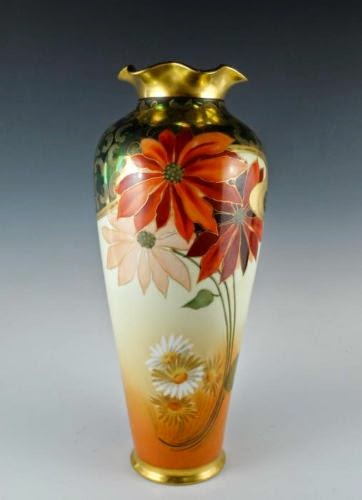
When it comes to decorating a home, adding antique pieces add a rich, layered sense of beauty (and history!). Now that spring is here, flowers and flower arrangements are definitely on my mind. Florals for spring may be a cliche, but I like to think of them as timeless instead. A beautiful floral-patterned vase can bring the feeling of spring to your home year-round. We have a few fantastic examples of fine quality hand painted floral decorated porcelain from Pickard that I wanted to show off this week.

Pickard China was founded by Wilder Pickard in Wisconsin in 1893, and soon moved in Chicago in 1897. Pickard began by offering hand painted art pieces, tea sets, and dessert sets. Pickard hired both male and female artists (many from the nearby Art Institute of Chicago, and many noted European painters) who created one-of-a-kind pieces. These early pieces of Pickard porcelain were painted on blanks imported from notable European makers.

The above vase was decorated by the German-born master painter Paul Gasper, an artist who worked for Pickard in the early 1900s. Gasper is known for his daisy motifs, which is featured on this vase along with vibrant red and pink poinsettias. The vase is accented with the artist's trademark gilded details and finished with a beautiful ruffled rim with a wide gilded border. Signed for Gasper as pictured.The blank vase was made by the Oscar & Edgar Gutherz (O. & E.G.) Royal Austria Factory.

Pickard China has been called a uniquely American style of hand painted china. One of the most sought after artists working at Pickard was M. Rost LeRoy, who painted for Pickard between 1898 and 1905. LeRoy left Pickard to join the Donath Studio which was founded by another ex-Pickard artist. This elegant pitcher at the right is a striking example of LeRoy's work: the tall form is extensively gilded and features a vivid scene of ripe cherries on the branch. The porcelain blank came from Limoges, France. The pitcher has an unusual Pickard hallmark which is infrequently found.

Because Pickard purchased its blanks from porcelain factories, antique Pickard pieces will usually have two maker's marks on the bottom: the porcelain factory's trademark, and Pickard's trademark that was applied upon decoration. Pickard remained a decorating studio only until the 1930s when they began producing their own line of porcelain blanks to be painted. Antique pieces of Pickard decorated porcelain can be difficult to find in excellent condition in large sizes like this vase and pitcher.

You can find more porcelain in the Nine Caroline Antiques store here.

Or explore all of the categories of fine antiques and collectibles at Nine Caroline Antiques.

Monday, March 16, 2015

Depictions of the Bacchanalia

The blog has moved!
Visit us at www.ninecarolineantiques.com for updated blog content
View this blog entry on the updated Nine Caroline Antiques website

Today marks the beginning of the first day of the Bacchanalia, the ancient Roman festivals celebrating the god Bacchus. Bacchus (the Roman version of the Greek god Dionysus) was the god of wine and the grape harvest, winemaking and intoxication, fertility and epiphany. The Bacchanalia festivals take place in early Spring, and possibly began as fertility rites. The celebrations also included processions and dramatic performances as well as religious rites, but the "drinking feasts" are perhaps the most well-known aspect of the Bacchanalia today. The term bacchanalia or bacchanal has come to describe any type of uninhibited (and often drunken) revelry.


The flowering of the Renaissance spurred developments in all areas of society, but it is perhaps best known for its remarkable innovations in visual art. The Middle Ages had not approved of the licentious traits associated with Bacchus/Dionysus, to say the least. Renaissance artists embraced the theme of the Bacchanalia, restoring the god of wine as an appropriate subject by associating Bacchus' life-birth-rebirth cycle with the Christian resurrection. The bacchanal in art also allowed artists to freely depict reveling nude figures under the respectable aegis of "mythology", and it remained a popular theme in art long after its association with Christian resurrection faded away.

In decorative art, the Bacchanalia will often be seen on such items as wine decanters, pitchers, or snuff boxes. These socially acceptable vices are the perfect backdrop for scenes of partying gods and mortals. The antique silver pill box depicted at the upper left is a charming depiction of a traditional bacchanal scene, with dancing nymphs in a woodland landscape.

The pitcher at the right is a nice example of the subtle use of the Bacchanal theme during the Victorian era. The silver plated pitcher is crafted in the Aesthetic style, with an ornately decorated form. The pitcher features a finial of a small figure of Bacchus, holding a goblet of wine in an eternal toast.

Today, there is a wide variety of decorative and fine art depicting bacchanal scenes, which is quite wonderful for anyone interesting in collecting these festive pieces. We have scene this motif illustrated in jewelry, trinket boxes, pottery and porcelain, and so much more. It's a delightful sub-category of fine and decorative art inspired by Classical mythology. The pieces illustrated in this post can be found in our store, and we are always coming across new and beautiful Bacchanalia-themed objects.

Thursday, March 5, 2015

Niels Erik From: Modernist Scandinavian Jewelry

The blog has moved!
Visit us at www.ninecarolineantiques.com for updated blog content
View this blog entry on the updated Nine Caroline Antiques website

No designer does Modernist quite like Scandinavian designers. This extraordinary pendant necklace by Niels Erik From is a beautiful example of the heights of Scandinavian jewelry design.

Niels Erik From (1908—1982) is considered among the greats of Danish silver design, along with such notable names as Georg Jensen. From trained as a silversmith and opened his first workshop in 1931 at the age of 23.

From's early jewelry pieces reflect the Skønvirke style, a Scandinavian development of the Art Nouveau and Arts and Crafts movements. These early pieces are explorations of the Arts & Crafts and Art Nouveau interest in naturalistic designs incorporating flowers, leaves, and other foliage, as well as animal motifs. The pieces were usually beautifully detailed and have a rather romantic air.

This pendant necklace is a striking example of the later Modernist pieces that came out of From's workshop. The necklace is hand crafted with a boldly sinuous shape crowned by a large translucent amber cabochon. The Modernist designs are striking yet simple, with a sculptural elegance.

This pendant is hallmarked "NE From Sterling Denmark 925s", but smaller pieces are sometimes simply marked "From" or "N.E. From" in an italic script.


You can find more example of Scandinavian (primarily Danish) design here.

Examine this Niels Erik From pendant necklace in greater detail.